| Deshae Betts, IFBB Pro | Strength Training | 9 min read
Free Weights vs. Machines: Which Builds More Muscle?
Free weights and machines both build muscle — but they do it differently. Here's when to use each one based on your goals, experience, and what you're training.
The free weights vs. machines debate has been going on for decades — and the real answer is that both build muscle effectively, but through different mechanisms. Free weights recruit more stabilizer muscles and mimic real-world movement patterns, while machines provide controlled resistance that’s safer for beginners and better for isolating specific muscles. The smartest approach is using both strategically based on your goals and experience level.
Why This Debate Matters
Walk into any gym and you’ll see two camps: people who swear by barbells and dumbbells, and people who stick exclusively to machines. Both groups are leaving results on the table.
Understanding when and why to use each type of resistance equipment helps you build a more effective training program — whether you’re brand new to lifting or you’ve been training for years. If you’re just getting started, our complete strength training guide covers the fundamentals you’ll need before diving into equipment selection.
Free Weights vs. Machines: Side-by-Side Comparison
| Category | Free Weights | Machines |
|---|---|---|
| Muscle activation | Higher overall — recruits stabilizers | Targeted — isolates primary movers |
| Stabilizer engagement | Significant | Minimal |
| Safety for beginners | Requires proper form | Guided path reduces injury risk |
| Learning curve | Steeper — form matters a lot | Shorter — instructions on the machine |
| Versatility | One barbell = dozens of exercises | One machine = 1-3 exercises |
| Training to failure | Needs a spotter or safety pins | Built-in safety — just release the weight |
| Functional carryover | High — mimics real-world movements | Lower — fixed plane of motion |
| Cost/space (home gyms) | Compact and affordable | Expensive and space-intensive |
Both sides have legitimate advantages. Let’s break them down.
The Case for Free Weights
Greater Muscle Activation
Research consistently shows that free weight exercises activate more total muscle fibers than their machine equivalents. A 2020 study published in the Journal of Strength and Conditioning Research found that the barbell bench press produced significantly higher muscle activation in the pectoralis major and anterior deltoid compared to the Smith machine bench press. The difference comes from stabilizer muscles — your body has to balance and control the weight in three dimensions, not just push it along a fixed track.
Functional Movement Patterns
Every time you pick up a heavy box, carry groceries, or lift a child off the ground, you’re performing a free weight movement pattern. Squats, deadlifts, overhead presses, and rows all train your body to produce force the way it actually moves in real life.
The American College of Sports Medicine recommends multi-joint free weight exercises as foundational movements for developing functional strength. These compound lifts — squats, deadlifts, bench press, rows — should form the backbone of most training programs.
Versatility
A single barbell and a set of plates can be used for dozens of exercises: back squats, front squats, bench press, overhead press, barbell rows, deadlifts, Romanian deadlifts, hip thrusts, lunges, curls, and more. Add a pair of adjustable dumbbells and you’ve doubled that number. Learning proper squat form alone unlocks multiple squat variations that each target muscles differently.
Better for Athletic Performance
Athletes across virtually every sport prioritize free weights. The unstable nature of a barbell or dumbbell forces your nervous system to coordinate multiple muscle groups simultaneously — the same coordination required in sports. A 2016 meta-analysis in Sports Medicine found that free weight training produced greater improvements in sport-specific performance measures compared to machine-based training.
The Case for Machines
Safer for Beginners
If you’ve never lifted weights before, a leg press is far less intimidating than a barbell squat — and for good reason. Machines guide the weight along a fixed path, which means you can focus on pushing or pulling without worrying about balance, bar path, or dropping weight on yourself.
This matters because form errors under heavy load are how injuries happen. Machines reduce that risk substantially. For anyone dealing with gym anxiety, machines are an excellent entry point that builds confidence fast.
Superior for Isolation Work
Want to target your rear delts without your traps and lats taking over? A reverse pec deck machine does that better than any free weight exercise. Machines excel at isolating individual muscles because they remove the stabilization demand.
This is particularly valuable for:
- Bodybuilding and hypertrophy — isolating lagging muscle groups
- Rehab — strengthening a specific muscle after injury without loading surrounding joints
- Pre-exhaustion — fatiguing a target muscle before compound lifts
Training to Failure Without a Spotter
Pushing a set to true muscular failure on a barbell bench press without a spotter is genuinely dangerous. On a chest press machine, you just stop pushing and the weight returns to the stack. This safety feature makes machines ideal for high-intensity techniques like drop sets, rest-pause sets, and failure training.
Research from the Journal of Sports Science & Medicine has shown that training to or near muscular failure is an important factor for maximizing hypertrophy. Machines let you do this safely on every exercise.
Excellent for Rehab and Working Around Injuries
When you’re recovering from a shoulder injury, the last thing you want is an unstable load that your injured joint has to stabilize. Machines allow you to load a target muscle while minimizing stress on the joints you’re protecting. Physical therapists regularly use machine-based exercises in rehabilitation protocols for exactly this reason.
When to Use Each: Goals-Based Recommendations
If You’re a Beginner
Start with machines, then progress to free weights. Machines teach you what each movement should feel like — the pushing motion of a chest press, the pulling motion of a lat pulldown — without requiring balance or coordination you haven’t developed yet. After 4-6 weeks on machines, start incorporating free weight exercises like goblet squats, dumbbell presses, and dumbbell rows. Our beginner’s strength training guide outlines this progression in detail.
If Your Goal is Hypertrophy (Building Muscle)
Use both — they’re complementary. Start your workouts with compound free weight movements (bench press, squat, deadlift, rows) when you’re fresh and can maintain proper form. Then finish with machine exercises for isolation work and higher-rep sets where you can safely push closer to failure.
A sample chest workout using this approach:
- Barbell bench press — 4x6-8 (strength and compound stimulus)
- Incline dumbbell press — 3x8-10 (free weight, different angle)
- Machine chest press — 3x10-12 (controlled, push closer to failure)
- Cable fly — 3x12-15 (isolation, constant tension)
If Your Goal is Strength or Powerlifting
Prioritize free weights. Strength sports are tested with barbells, so the principle of specificity demands that you train primarily with barbells. Machines can still play a supporting role — leg press for quad volume, lat pulldown for back development, leg curls for hamstring health — but the squat, bench, and deadlift should be the centerpiece.
If You’re Rehabbing an Injury
Start with machines, reintroduce free weights gradually. Machines let you load the target muscle while controlling the range of motion and minimizing joint stress. As you recover, progressively shift toward free weight variations that introduce controlled instability. Always work with a qualified trainer or physical therapist during rehab.
The Real Answer: Use Both
The best training programs don’t pick sides. They use free weights for compound movements, functional strength, and athletic performance. They use machines for isolation, safety, intensity techniques, and rehab.
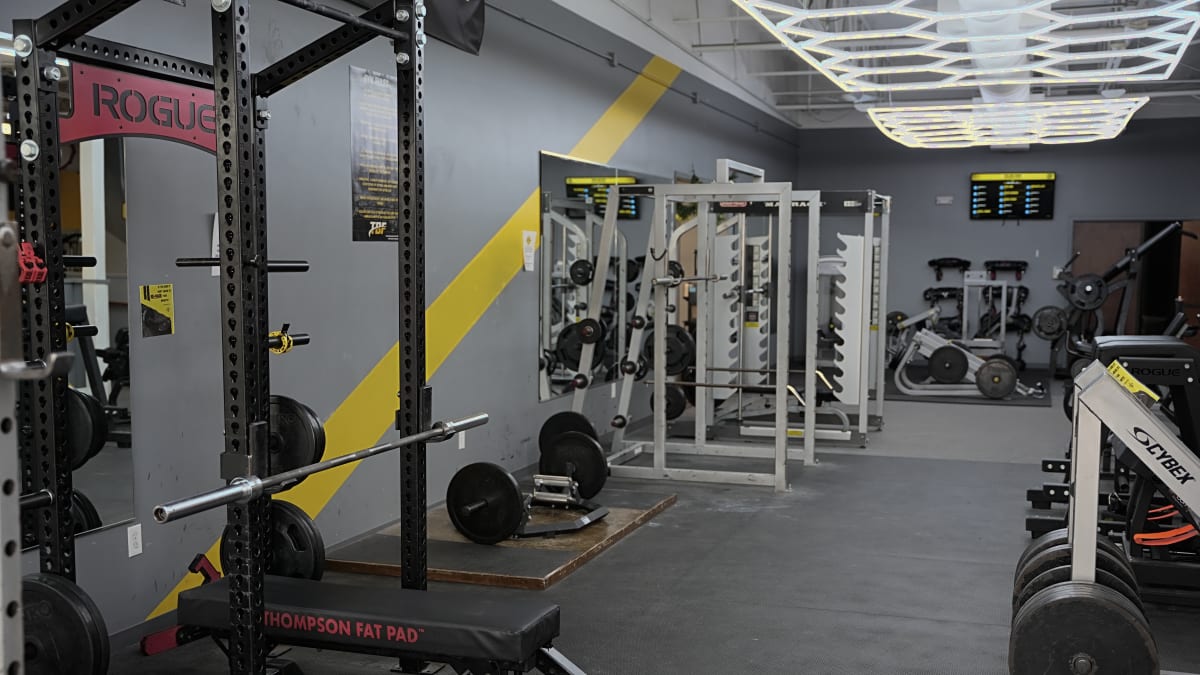
At Total Body Fitness, we equip the gym with both for exactly this reason. Multiple power racks, dedicated deadlift platforms, dumbbells from 5 to 80+ pounds, plus a full lineup of plate-loaded and cable machines. Whether your workout calls for heavy barbell squats or high-rep cable flyes, the equipment is there. Equipment variety is one of the most important factors when choosing a gym in Lee’s Summit — you want a facility that supports your program, not one that limits it.
If you’re not sure how to structure a program that uses both effectively, that’s exactly what personal training is for. A coach can assess your goals, experience, and any limitations, then build a plan that puts the right tool in your hands for every exercise.
Frequently Asked Questions
Are free weights better than machines for building muscle?
Not necessarily — both build muscle effectively through different mechanisms. Free weights tend to activate more total muscle fibers because your body must stabilize the load in addition to moving it, which can lead to greater overall muscle recruitment per exercise. However, machines allow you to isolate specific muscles more effectively and train safely to failure, which is a key driver of hypertrophy. Research published in the Journal of Strength and Conditioning Research shows that when training volume and intensity are equated, both modalities produce comparable muscle growth. The optimal approach for hypertrophy is using free weights for compound movements and machines for targeted isolation work.
Should beginners start with machines or free weights?
Beginners generally benefit from starting with machines for the first 4-6 weeks. Machines guide movement along a fixed path, which reduces injury risk and helps you learn what each movement pattern should feel like without needing to coordinate balance and stabilization simultaneously. Once you’ve built a foundation of strength and body awareness, start incorporating dumbbell exercises (goblet squats, dumbbell rows, dumbbell bench press), then progress to barbell movements. This gradual progression builds competence and confidence without overwhelming you on day one.
Can you build a complete physique using only machines?
You can build an impressive physique using primarily machines — many bodybuilders use machines extensively, especially for isolation work and training around injuries. However, exclusively using machines means missing out on the stabilizer muscle development and functional strength that free weight compound movements provide. For general health, athletic performance, and well-rounded muscular development, incorporating at least some free weight work (especially squats, deadlifts, rows, and presses) is recommended by organizations like the NSCA.
Do machines count as “real” weightlifting?
Absolutely. Machines apply resistance to your muscles — that’s the fundamental requirement for building strength and muscle. The idea that machines are somehow inferior or “not real lifting” is gym culture gatekeeping, not science. Machines are used by physical therapists for rehab, by elite bodybuilders for isolation work, and by experienced lifters of all levels for specific training purposes. What matters is progressive overload — consistently challenging your muscles with increasing resistance over time — and that can be achieved with free weights, machines, cables, bands, or bodyweight.
Build Your Program With the Right Tools
Whether you’re drawn to barbells or prefer machines, the most important thing is training consistently with progressive overload. If you want help figuring out the right mix for your goals, check out our membership options or call (816) 403-4910 to talk about what you’re looking to accomplish. We’re open 24/7 and happy to point you in the right direction.
Written by Deshae Betts, IFBB Pro and owner of Total Body Fitness in Lee’s Summit, MO. She coaches athletes from first-time gym members to competitive bodybuilders and holds certifications in personal training and nutrition.